

What Is Sciatica?
Sciatica is a term used to describe pain and other symptoms that occur when a nerve root in the lower back becomes irritated, inflamed or compressed.
The symptoms usually travel from the lower back or buttock into the leg, sometimes continuing as far as the foot and toes. Sciatica can cause much more than pain. It may also produce tingling, pins and needles, numbness or weakness in the leg.
The sciatic nerve is the largest nerve in the human body. It is formed from several nerve roots that leave the lower part of the spinal cord and lower spine. These nerve roots join together in the pelvis to form the sciatic nerve, which travels through the buttock and down the back of the leg.
Sciatica is therefore not simply a problem with the muscles of the buttock or leg. The symptoms often originate from irritation of a nerve root in the lower spine.
It is important to remember that not every pain travelling into the leg is sciatica. Several other conditions can produce very similar symptoms, which is why a proper examination is important.
Sciatica Anatomy – Understanding the Sciatic Nerve
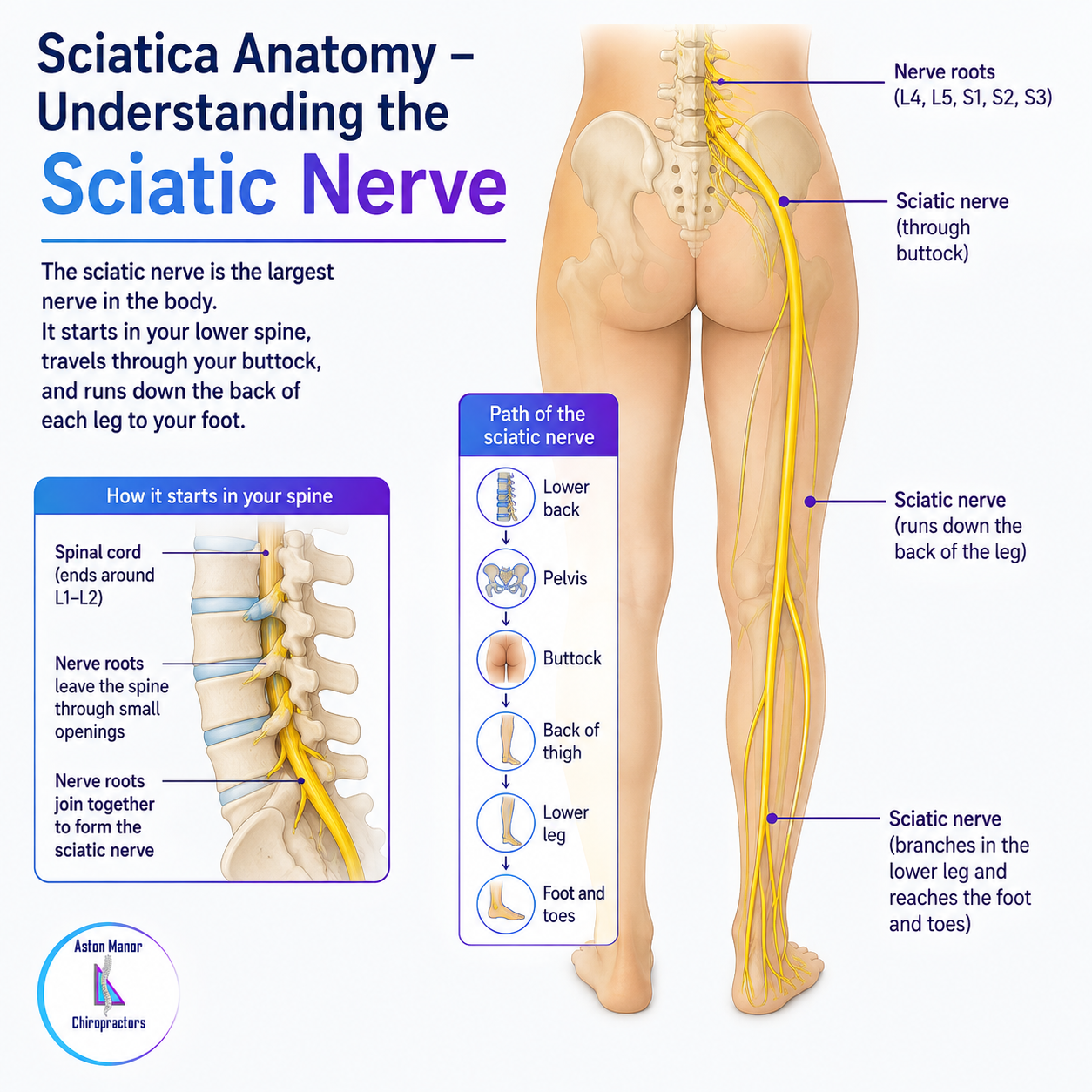
Your spine is made up of individual bones called vertebrae. Between most of these bones are discs that act as cushions and allow the spine to move.
Inside the spinal column is the spinal cord. At the lower end of the spinal cord, bundles of nerves continue through the lower spine.
These nerves leave the spine through small openings between the vertebrae. They supply the muscles, skin and other structures of the legs.
Several of these nerve roots come together to form the sciatic nerve.
The sciatic nerve then travels:
Lower back → pelvis → buttock → back of thigh → lower leg → foot
Because the nerve supplies a large part of the leg, irritation of one of its nerve roots can produce symptoms over a surprisingly large area.
What happens when a nerve is irritated?
A nerve does not have to be severely compressed to become painful.
Pressure, inflammation or chemical irritation around a nerve root can interfere with the way the nerve functions.
Sciatica often feels different from ordinary muscular or joint pain.
Common symptoms include:
Symptoms can change with position:
Sciatic symptoms may become worse with:
However, symptoms can vary considerably from person to person.
What Causes Sciatica?
Sciatica occurs when a nerve root or the sciatic nerve itself becomes irritated or compressed.
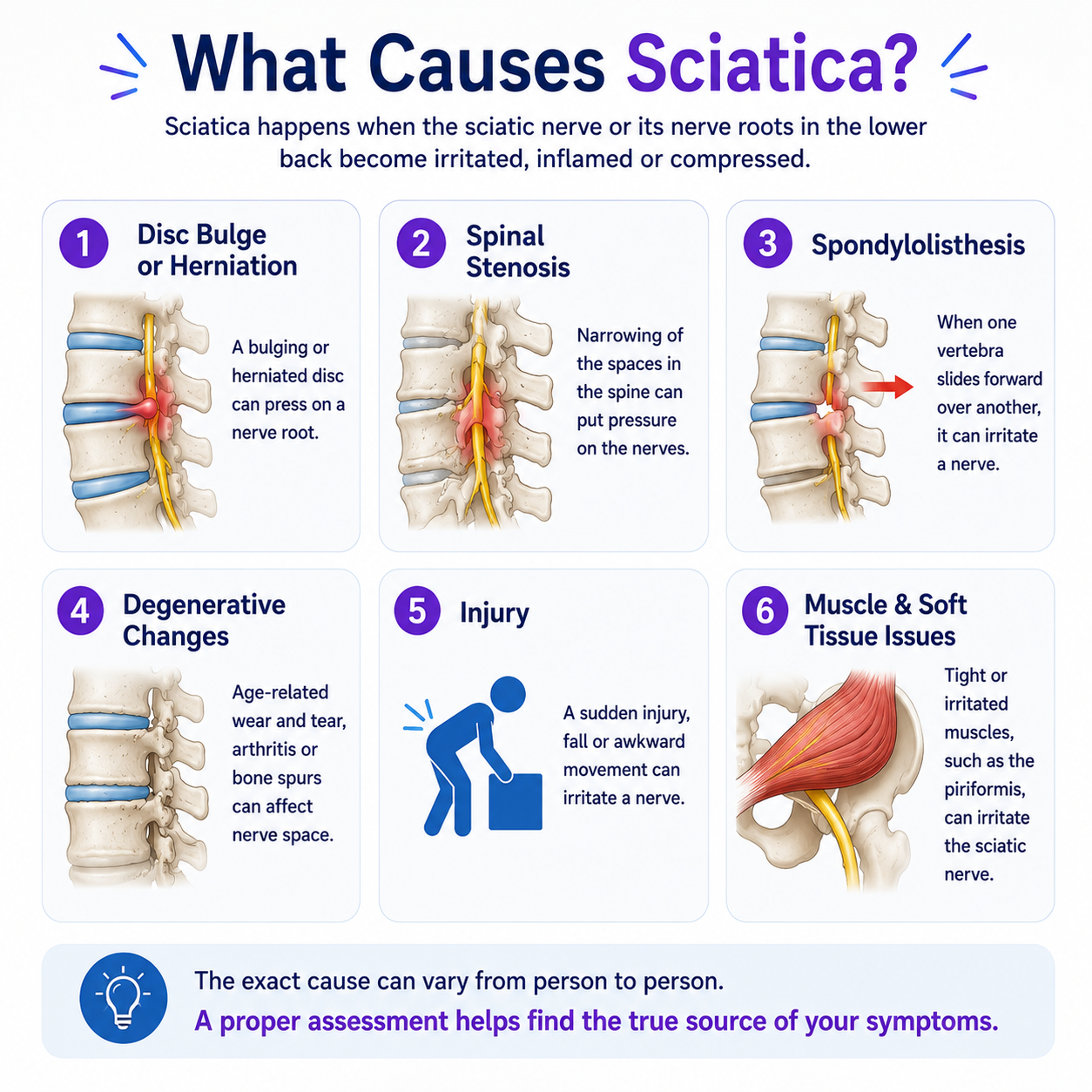
There are several possible causes.
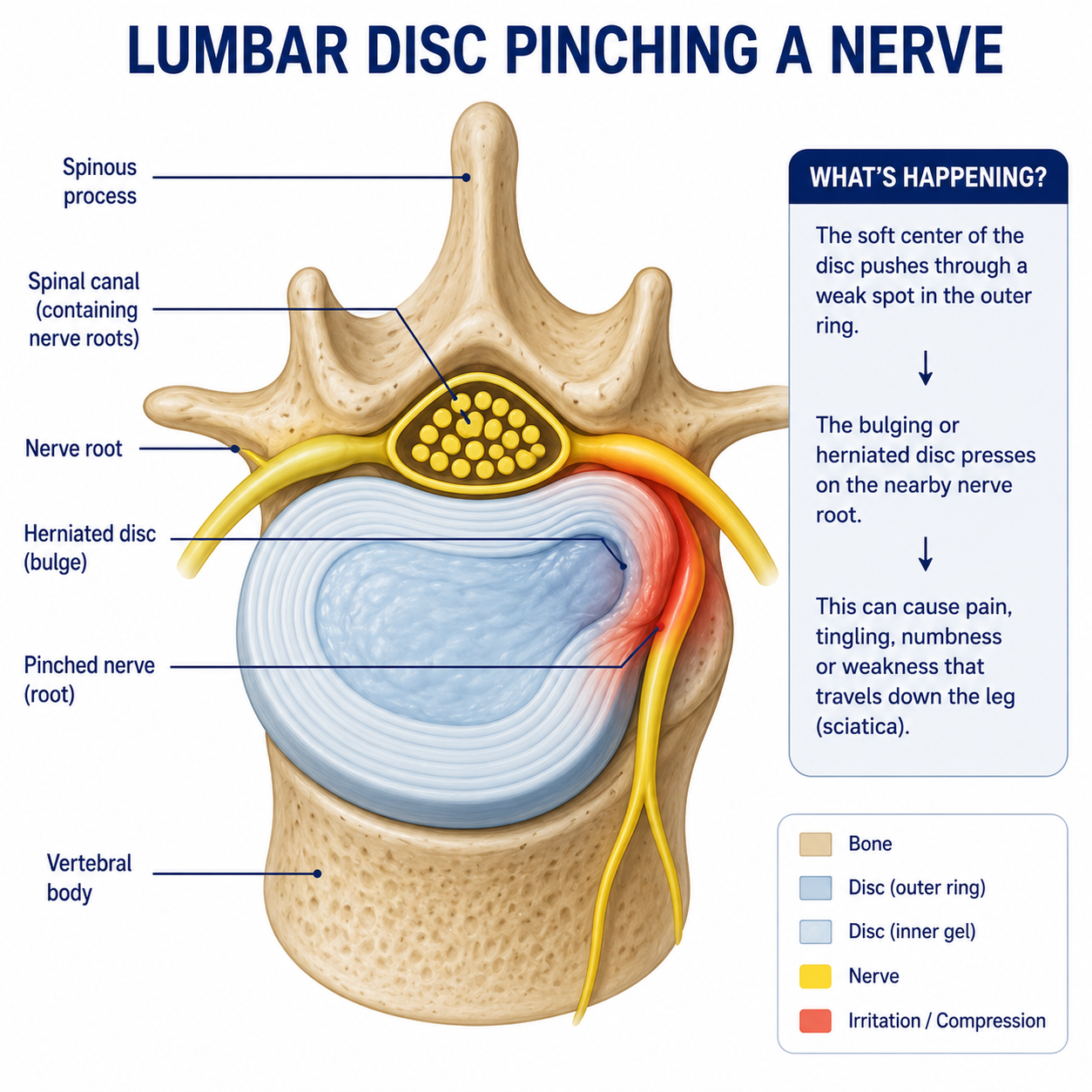
This is one of the most common causes of sciatica.
Between the vertebrae are discs made of a tough outer layer surrounding a softer inner material.
A disc can develop a bulge or herniation. If the disc material irritates or presses against a nearby nerve root, it can produce sciatic symptoms.
This is sometimes referred to as a "slipped disc", although the disc does not actually slip out of the spine.
A disc problem does not automatically mean that surgery is required. Many disc-related cases improve with conservative treatment.
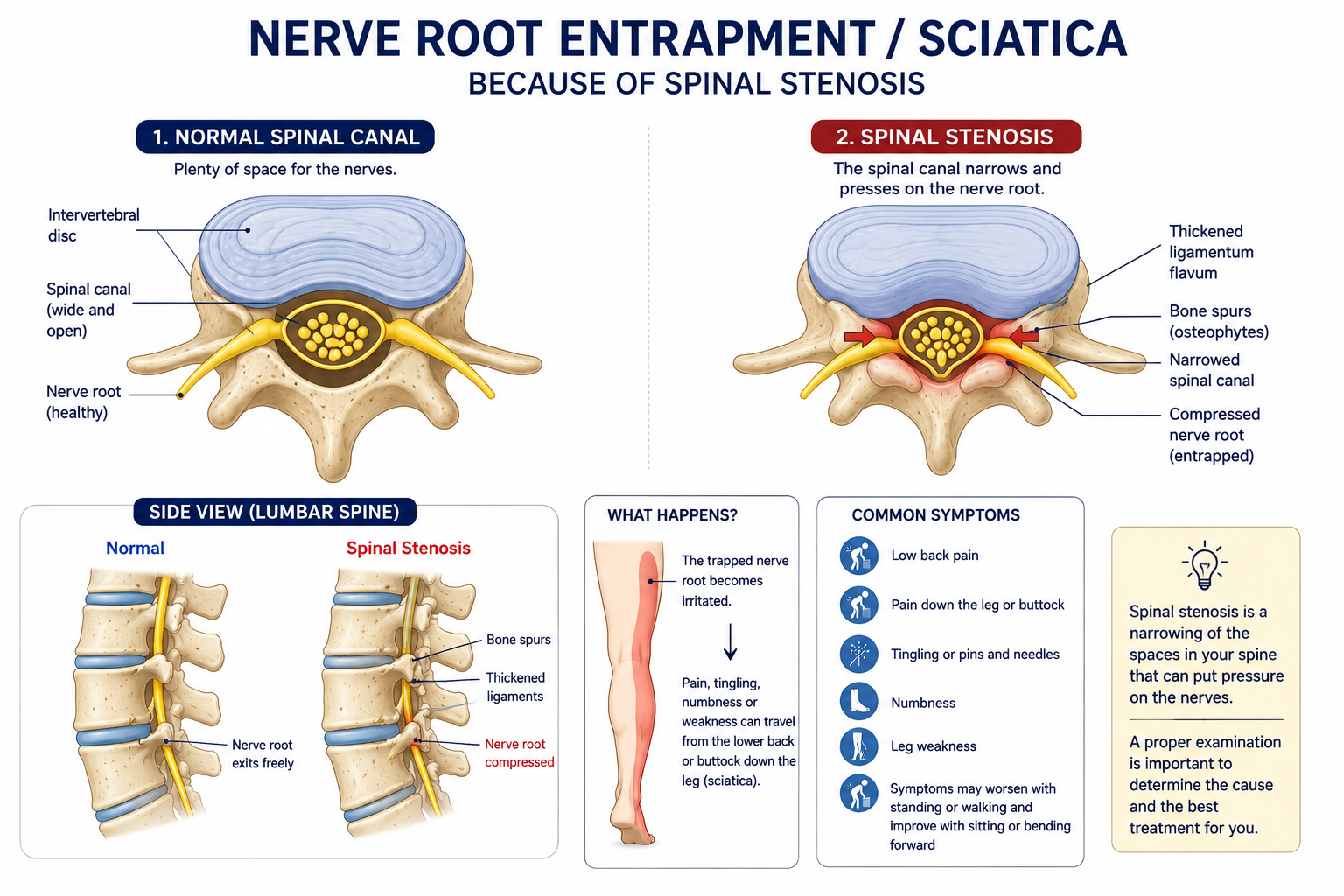
Spinal stenosis means narrowing around the spinal canal or the openings through which the nerves travel.
As we age, changes such as disc degeneration, thickening of ligaments and arthritic changes in the joints can reduce the available space for the nerves.
This may irritate or compress the nerve roots.
Symptoms can sometimes become worse when standing or walking and improve when sitting or leaning forward.
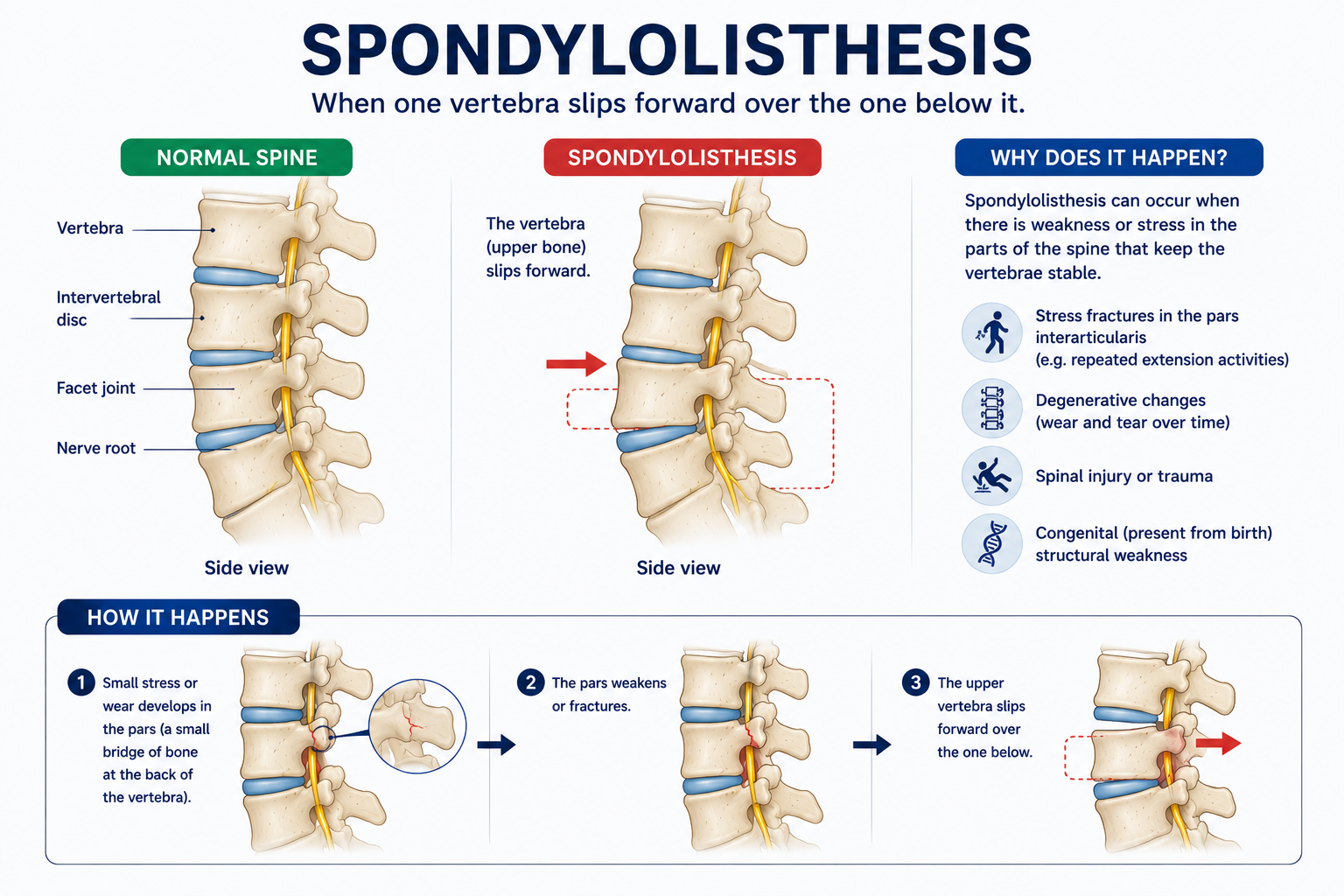
Spondylolisthesis occurs when one vertebra moves forward relative to another.
This can alter the space available for the nerves and, in some people, contribute to nerve irritation and sciatica.
As we get older, the discs and joints of the spine naturally change.
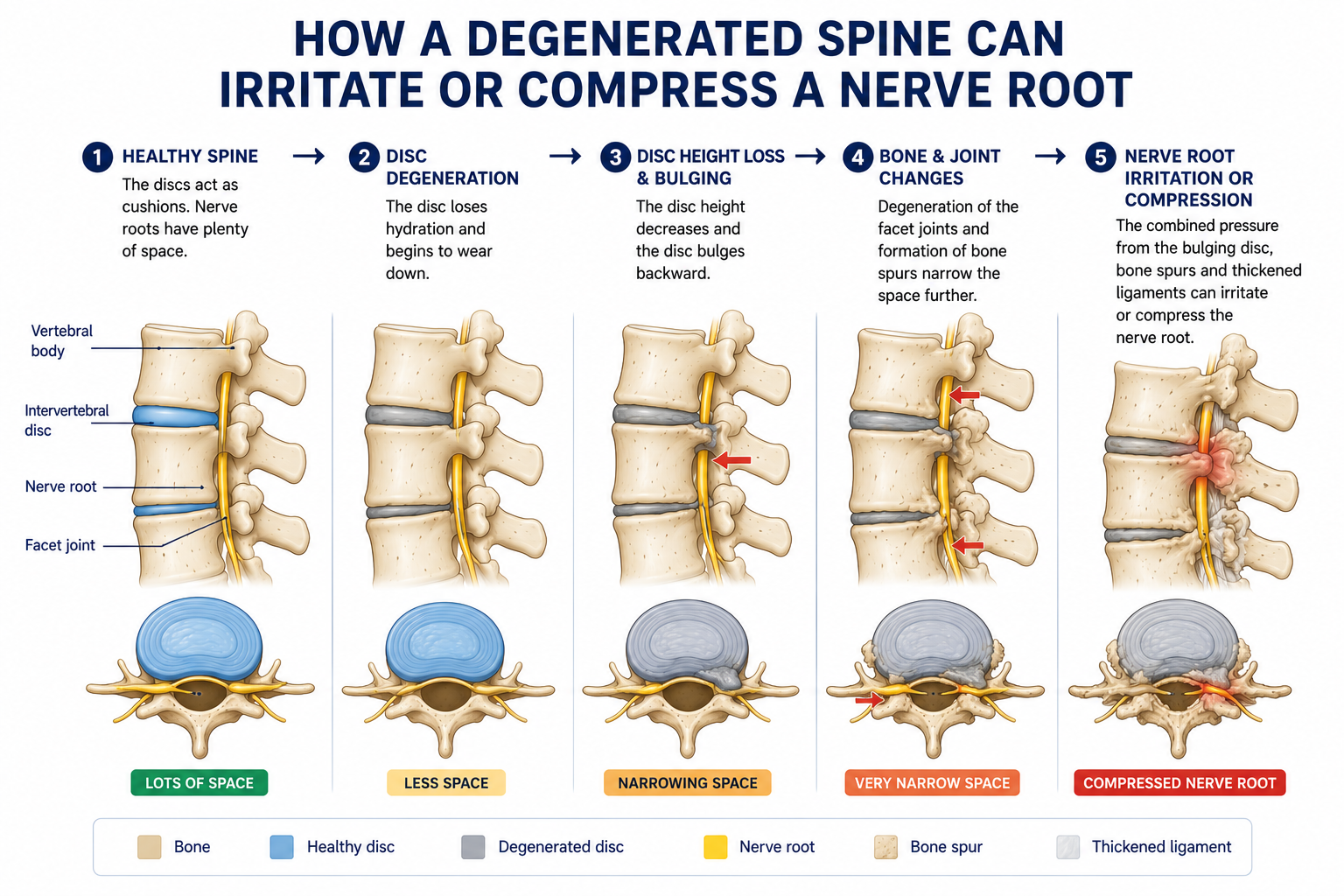
These changes may include:
These changes are extremely common and do not always cause pain.
However, in some people they can contribute to narrowing around a nerve and the development of sciatic symptoms.
A sudden injury, fall, lifting incident or other trauma can irritate structures around the spine and contribute to nerve irritation.
In some cases, structures outside the spine can irritate the sciatic nerve.
For example, irritation around the deep muscles of the buttock, including the piriformis muscle, can produce symptoms that resemble sciatica.
This is one reason why it is important not to assume that every pain travelling down the leg is caused by a disc.
Who Is More Likely to Develop Sciatica?
Sciatica can affect almost anyone, but certain factors can increase the likelihood of developing back and nerve-related problems.
These may include:
However, sciatica can occur even when none of these factors are present.
Sciatica or Something Else?
This is one of the most important reasons to have your symptoms assessed.
Pain down the leg does not automatically mean sciatica.
Several conditions can produce similar symptoms.
Possible differential diagnoses include:
Some of these conditions require very different treatment.
This is why a proper clinical examination is important, as addressing the cause will lead to a faster resolution of the pain.
Sciatica or Something Else?
When you visit a chiropractor for suspected sciatica, the aim should not simply be to find a painful area and treat it.
The first step is to determine: What is causing your symptoms?
An assessment may include:
The findings help determine whether conservative chiropractic care is appropriate or whether you should first be referred for further medical investigation.
Imaging such as an MRI or x-rays are not automatically required for every person with sciatica.
Treatment for Sciatica
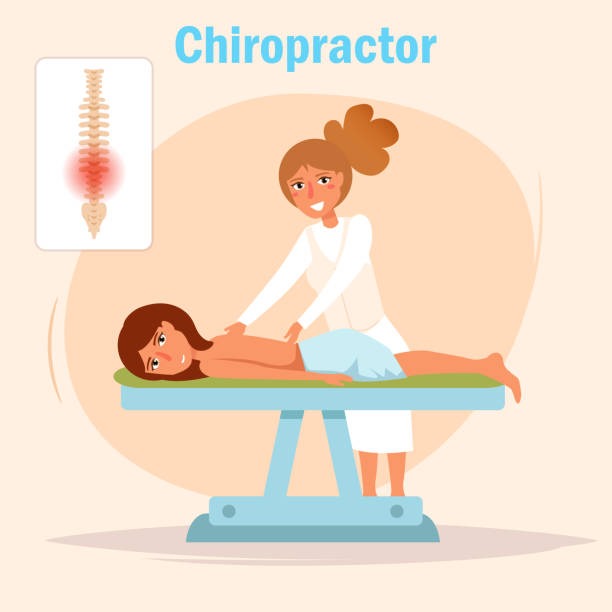
Treatment depends on the cause, severity and duration of your symptoms.
There is no single treatment that is appropriate for every person with sciatica.
A treatment programme may include a combination of:
The aim is not simply to make the pain disappear temporarily.
The aim is to help you:
Reduce pain → restore movement → improve strength and function → return to normal activities → reduce the risk of future problems
Having sciatica does not automatically mean that you need surgery or extensive treatment.
Persistent or worsening nerve symptoms can affect every aspect of your life. The sooner the healing process starts the sooner you will be able to continue with your normal life, and the better the long term outcome will be.
What Happens If Sciatica Is Left Alone?
Usually, sciatica improves without permanent nerve damage.
However, a nerve that remains significantly compressed or injured can lose function.
This may result in:
The risk varies considerably depending on the cause and severity of the nerve problem.
This is why progressive weakness, significant numbness or changes in bladder or bowel function should never simply be treated as ordinary back pain.
When Is Sciatica an Emergency?
Seek urgent medical attention if you develop:
These symptoms can indicate cauda equina syndrome, a rare but serious condition in which the bundle of nerves at the bottom of the spinal canal becomes severely compressed.
This requires urgent medical assessment.
How Long Does Sciatica Take to Recover?
Recovery varies according to the underlying cause.
Some people improve considerably within a few weeks.
Others may take several months.
Some people can experience recurring episodes or develop persistent symptoms.
Recovery can depend on:
Can Sciatica Require Surgery?
Most people with sciatica do not require surgery.
However, surgery may be considered when:
Surgery is therefore not necessarily the first option, but neither should it be unnecessarily delayed when there is a genuine neurological indication.
What Can You Do to Help Your Recovery?
If you have uncomplicated sciatica, prolonged bed rest is generally not recommended.
Where possible:
The Bottom Line
Sciatica can range from a temporary irritation of a nerve that settles within weeks to a more significant problem involving persistent nerve compression and neurological changes.
Most people recover well — but not everyone has the same cause or long-term outcome.
That is why it is important to determine what is actually causing your symptoms rather than simply assuming that every pain travelling down the leg is "sciatica".
At Aston Manor Chiropractors, our assessment is designed to determine whether your symptoms are consistent with a condition that can be managed conservatively, whether chiropractic care may be appropriate, or whether you should be referred for further medical investigation.
Our goal is not simply to treat pain.
It is to understand the cause, identify any nerve involvement, determine the safest treatment approach and help you get back to the activities that matter to you.
This information is provided for educational purposes and does not replace an individual medical or chiropractic assessment. Sciatica has several possible causes, and treatment should be based on the findings of an appropriate clinical examination.